Why Arizona, Why Now: The North Phoenix Boom, the Water Story & the Case for Moving Here
August 20268 min readIvy Realty
A balanced, up-to-date look at where Arizona really stands in 2026 — a steadier housing market, a $265 billion semiconductor engine reshaping North Phoenix, new homes with real value near Lake Pleasant, and a water picture that is being actively managed, not feared.
A Fair Look at Arizona in 2026
Arizona gets a lot of headlines — some breathless, some gloomy. The reality on the ground is more encouraging and a lot more useful. The Valley of the Sun keeps drawing new residents for the same reasons it always has: sunshine most days of the year, wide-open space, relative affordability compared to the coasts, and a lifestyle that blends city convenience with easy access to lakes, trails, and mountains.
What has changed is the engine underneath it all. North Phoenix is in the middle of one of the largest private investments in American history, home prices have found a healthier balance, and the state's water future is being managed through real, signed agreements rather than crossed fingers. This is an honest, data-backed tour of where things actually stand.
The Housing Market: Balanced, Not Frenzied
After the pandemic-era spike and the rate-driven cooldown that followed, the Phoenix market has settled into something healthier. As of June 2026, the median sale price across the metro sits near $458,000–$465,000, up a modest 1.6%–3.1% year over year, with single-family homes at a median around $475,000 (up 1.9%). This is steady appreciation — neither a crash nor a boom.
Inventory has loosened enough to give buyers room to breathe. Metro-wide active listings are in the 23,000–25,000+ range, and roughly a quarter of listings have seen a price reduction. Homes are averaging around 52 days on market, and sellers are commonly offering concessions like rate buydowns and closing-cost credits. At the same time, sales volume rose 5.7% year over year in June 2026 — the fourth straight month of annual growth. Translation: demand is real, but buyers finally have negotiating power again.
The TSMC Effect: A New Economic Anchor in North Phoenix
The single biggest story reshaping the northern Valley is the Taiwan Semiconductor Manufacturing Company (TSMC) campus near the I-17 and Loop 303 corridor. TSMC's total committed investment in Arizona has grown to roughly $265 billion, with plans for 12 facilities — advanced chip fabs, packaging plants, and an R&D center. It is the largest greenfield foreign direct investment in U.S. history.
The first fab began high-volume production in late 2024, a second fab is targeting production in 2027, and a third broke ground in 2025. When fully operational, the campus is expected to create about 12,000 direct high-tech jobs, plus tens of thousands of construction roles and a wide web of supplier and service positions around it. The Greater Phoenix Economic Council projected that the first three fabs alone would generate roughly $32.9 billion in economic output and $1.4 billion in state tax revenue over 13 years. Chips made here go into products from companies like Apple and NVIDIA. For North Phoenix, that means durable, high-wage employment anchoring the whole region for decades.
Lake Pleasant & the North Valley: New Homes With Real Value
All that job growth has to live somewhere, and the corridor stretching from Norterra and Anthem up toward Lake Pleasant and Peoria has become the natural landing spot. The appeal is easy to understand: you are minutes from one of Arizona's best recreation lakes — boating, paddleboarding, fishing, and desert trails at Lake Pleasant Regional Park — while still within reach of the North Phoenix job centers.
The pricing is genuinely attractive by big-metro standards, especially with today's builder incentives:
•Union Park at Norterra (85085) — new homes starting in the mid-$400,000s, right in the TSMC corridor.
•Vistancia (Peoria) — a premier master-planned community with new phases like Northpointe starting around $470,000 and climbing into the $700s–$800s for larger builds.
•Anthem — established, family-friendly, with trails and water parks; larger luxury builds reach $800,000–$1M+.
•West Valley (Buckeye/Teravalis) — the most affordable new-construction entry point in the metro, starting in the mid-$330,000s.
Across these communities, builders are actively competing for buyers with permanent or temporary rate buydowns (often near 3.99%), closing-cost assistance, and included upgrades. With independent representation, those incentives can make a brand-new home's monthly payment surprisingly competitive with — sometimes better than — a comparable resale.
The Water Question, Answered Factually
No honest look at Arizona is complete without addressing water — and the real story is far more reassuring than the doomsday version. Arizona has planned for this for decades. The state's landmark 1980 Groundwater Management Act, its "assured water supply" rules requiring proof of a 100-year supply before new subdivisions are approved in major growth areas, and its practice of banking Colorado River water underground for dry years all put Arizona among the most forward-thinking water managers in the country. The Colorado River is only one of several sources; the Valley also draws on the Salt and Verde river system, groundwater, and a growing volume of recycled (reclaimed) water.
On the river itself, the news in 2026 has been about cooperation, not collapse. In May 2026, Arizona, California, and Nevada reached a landmark agreement to conserve more than 3.2 million acre-feet of Colorado River water through 2028 to stabilize Lakes Mead and Powell. Arizona is doing its share through committed reductions, and in the summer of 2026 the federal government finalized a new long-term framework guiding reservoir operations through 2036, including a first-of-its-kind Tribal water pool. The takeaway for a homeowner: this is a system being actively, collaboratively managed by the people whose job it is to manage it — and Arizona has been leading that work, not scrambling to catch up.
Jobs, People & the Bigger Picture
The broader Arizona economy is growing steadily rather than explosively — and that is a good thing for stability. Economists at the University of Arizona's Economic and Business Research Center pegged Phoenix job growth near 0.6% in 2025, with forecasts rising to roughly 0.7%–1.1% in 2026 and 1.2%–1.4% in 2027 as the region's momentum builds. Population continues to climb around 1.5% a year, driven mostly by people moving in from other states.
The drivers are diverse: semiconductors and advanced manufacturing anchored by TSMC and its suppliers, a large and growing healthcare sector, aerospace and defense, logistics, and a maturing technology base. Pair that with home prices well below California, Washington, and the Northeast, no state tax on Social Security income, and a cost of living that still stretches a paycheck further, and it is clear why the in-migration trend has held up.
What This Means If You Are Considering Arizona
If you are moving from out of state: you are arriving at a rare moment — a market with real inventory, motivated builders offering concessions, and a long-term economic anchor being built right now in North Phoenix. You have time to choose well instead of rushing.
If you already live here: the same balance that helps buyers also rewards well-prepared sellers. Price precisely, present the home professionally, and lean on hyper-local expertise.
If you are an investor: steady population growth and a diversifying job base support long-term rental demand, while flatter prices and improving cap rates make the math more workable than it was two years ago.
And If You Are (or Want to Be) a Real Estate Agent Here
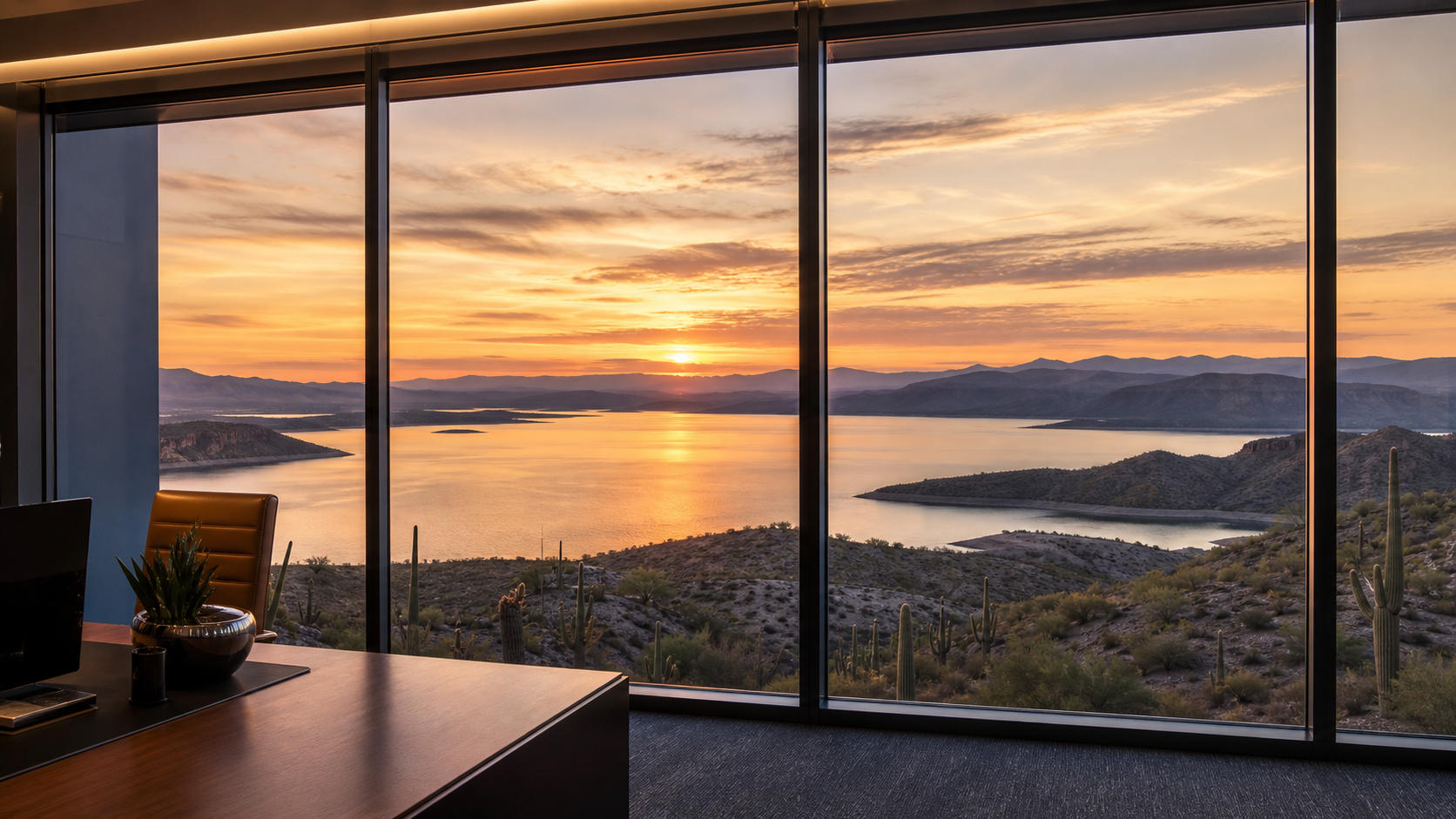
There may be no better place in the country to build a real estate career right now than the Valley of the Sun. You have a steady stream of new residents to serve, an entire tech corridor rising in North Phoenix, and builders eager to work with buyer's agents who understand new construction. The lifestyle is the same one you get to sell — sunshine, space, and views like the one above.
If you are thinking about getting licensed or looking for a brokerage that lets you keep more of what you earn while handing you the tools and training to grow, this is a great time to explore it. Arizona's market rewards agents who show up prepared — and the runway ahead looks long.
Arizona in 2026 is not the frenzy of 2021, and it is not the doom of the headlines either. It is a growing, well-managed region with a healthier housing market, a generational investment reshaping North Phoenix, genuine value in new-construction near Lake Pleasant, and a water future being handled through real agreements. For anyone weighing a move — or a career — here, the fundamentals are pointing the right direction.
Data drawn from Phoenix REALTORS® and metro market reports, the Greater Phoenix Economic Council, TSMC, the U.S. Bureau of Reclamation, and the University of Arizona Economic and Business Research Center, current as of August 2026. Home prices and builder incentives vary by community and change frequently.
With over 20 years of real estate experience in the Phoenix metro, Ivy Clay founded Ivy Realty as Arizona's first AI-native brokerage — combining cutting-edge technology with transparent, low-cost commission plans. She also built OnChainESign.App for blockchain-verified e-signatures and Munny.Pro for agent financial tools.
Whether you are relocating from out of state or upgrading across town, an Ivy Realty agent can walk you through neighborhoods, builder incentives, and the numbers that matter — with no pressure and no cost to start the conversation.



 •ivyrealty.ai